

Weekly Missionary Reflection
32nd Ordinary Sunday, 10 November 2024
1Kgs. 17:10-16; Ps. 146:7,8-9a,9bc-10; Heb. 9:24-28; Mark 12:38-44 (Mark 12:41-44)
The Law demanded protection for orphans, strangers, and widows. It made them depend on legal protection and economic subsidies. They also relied on the care and love of others. As a result, they were unable to give. And that is the irony in today’s Gospel. The Scribes were confronted with a poor widow. One devoured the house of widows; the other gave everything to God. One took, the other gave an offering. One stole, the other shared.
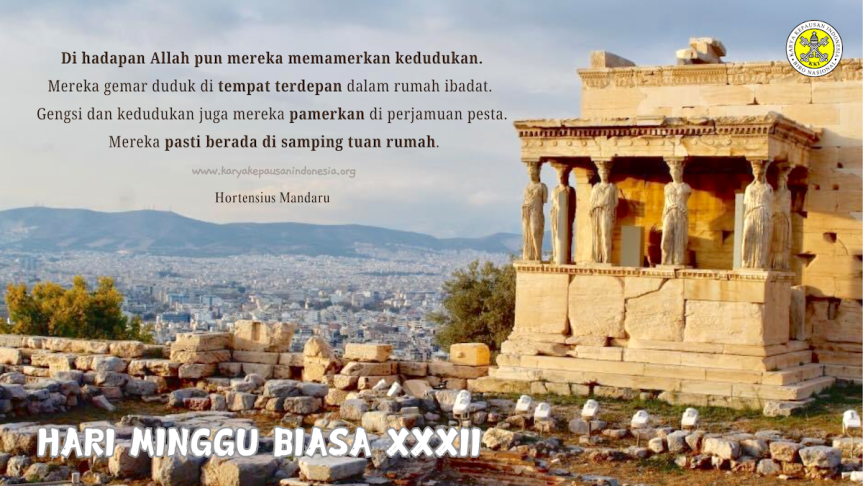
There are 6 (imperfect number) weaknesses of the Scribes: fond of wearing clothes of honor. A cloak implies honorable status. By wearing such apparel, they gained respect in the market. Before God, they also showed off their position. They liked to sit in front of the synagogue. They also showed off their prestige and position at party banquets. They would always be near the host. Anyway, they needed recognition. They were hungry for recognition. They desired to receive and accumulate respect. They served as legal advisors and defenders of the “weak.” However, legal advice was sometimes costly, so they took away the widow’s belongings instead of defending them. Their long prayers were also meant to exhibit piety.
In contrast to this respected elite, a poor widow is presented. Previously, Jesus had outlined the essence of the Law in the command to love God. That’s exactly what this poor widow showed. She gave all her money, and it was the only money left for that day. This is how she showed her total love for God. She performed the essence of the Law that Jesus taught. Not only that. By giving away her whole money, she practically gave away her entire life. The widow is presented as an ideal disciple of Jesus: she surrenders her whole life to God!
But this story has another side. Besides giving compliments, Jesus actually would like to criticize. He exposed the injustice of the Jewish order and worship. When praising the widow’s offering, Jesus was also lamenting her fate. The widow was poor, yet she still had to share her money with the Temple. Something was wrong with this system. Why did “religious obligation” become a burden, even impoverish people? It was this system that Jesus condemned as a “den of thieves” (Mark 11:17). Besides “being robbed” by the experts of religious law, the weak were also impoverished by the Temple offering system. Thus, this story has two sides. On one side, it invites us to imitate the widow: serve and love God. On the other side, this story also invites us to always strive for an order of living together and in a religion that is more just, equal, and prosperous for all. You and I are invited to rebuke any forms of oppression and impoverishment in any institution and system, including systems and institutions labeled as pious and holy.
(Hortensius Mandaru – Indonesian Bible Society)
DAILY DEDICATED PRAYER
Lord, our Father, I present my today prayer, thought, word, work, joy, and sorrow in unity with Your Son, Jesus Christ, who always presents Himself in the Eucharist for the salvation of the world. May the Holy Spirit animating Jesus, also be my guidance and strength today so that I am ready to be the witness of Your love.
Together with Mary, Mother of Jesus, and the Church, in particular, I present my prayer for our Pope and apostle prayer of the Indonesian Church this month:
Universal Church Intent: For anyone who has lost a child
We pray that all parents who mourn the loss of a son or daughter find support in their community and receive peace and consolation from the Holy Spirit.
Indonesian Church Intent: Elderly priests, brothers, and nuns
We pray that elderly priests, brothers, and nuns always find the burning love of God in their lives and willingly share the inspiration and love of God to young people.
Amen.
 Situs Resmi Karya Misi Kepausan Indonesia (KMKI)